
5 Signs Your Column Needs Structured Packing
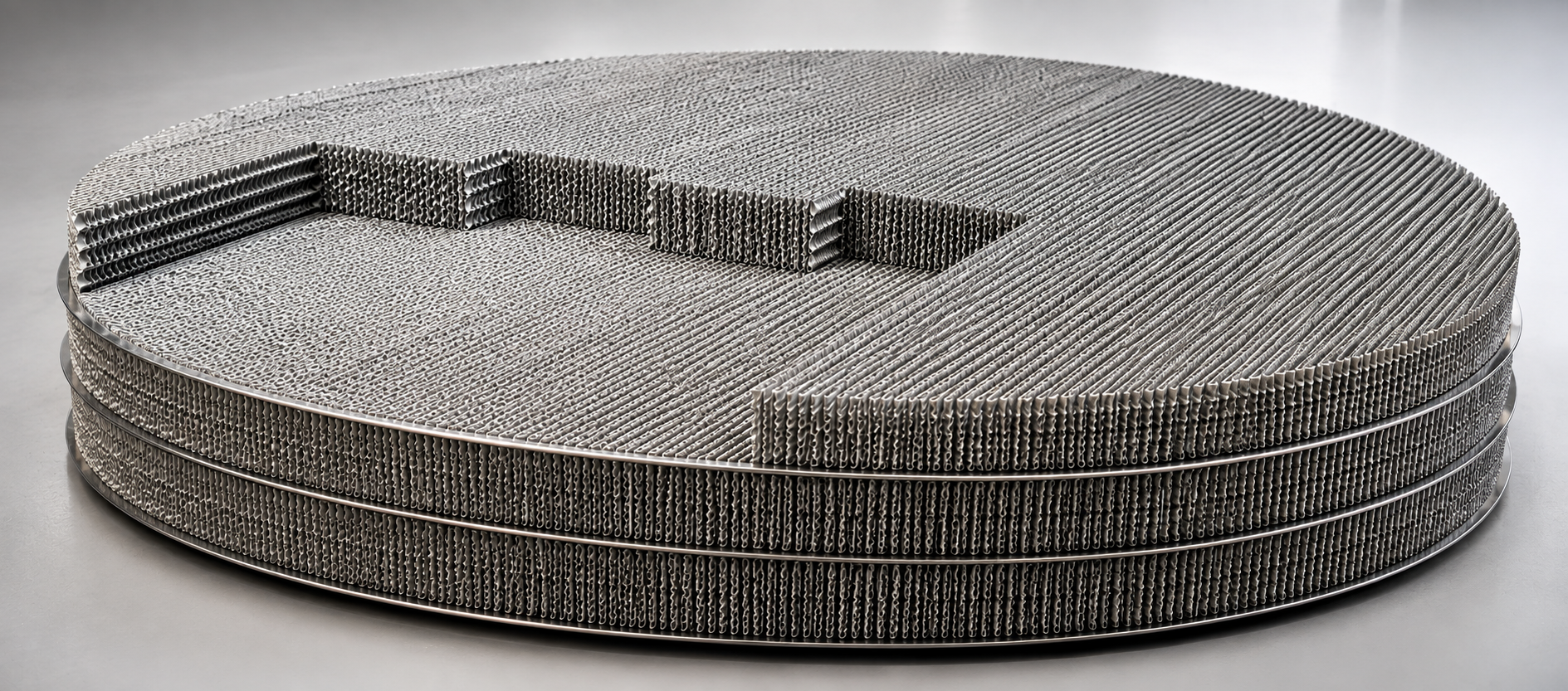
Flooding, weeping, and rising pressure drop can look nearly identical from the control room — a capacity ceiling, an efficiency drop, an upset that doesn’t resolve on its own. But each has a different cause, and each points to a different fix. Sometimes the answer is maintenance. Sometimes it’s a random packing swap. And sometimes the column has genuinely outgrown random packing and needs the higher capacity, lower pressure drop, or tighter separation that structured packing delivers. Here are five process conditions that indicate which situation you’re actually in.
1. Recurring Flooding or Entrainment Signals the Column Has Outgrown Random Packing
Flooding and entrainment are two points on the same failure curve, not two separate problems. Both are driven by vapor velocity that’s too high for the packing to handle. Entrainment starts first — vapor rising through the bed carries liquid droplets upward instead of allowing them to drain, degrading separation efficiency gradually as vapor rate increases. Pushed further, entrainment transitions into full jet flooding: liquid backs up faster than it can drain, pressure drop spikes, and separation collapses.
If either is showing up repeatedly at rates the column used to run cleanly, that’s not an operating problem to work around — it’s a sign the packing’s capacity ceiling has been reached. Random packing has a lower flood point than structured packing at equivalent column diameters, because its geometry creates more resistance to vapor flow per theoretical stage. Structured packing’s open, engineered channels raise that ceiling substantially, which is why it’s the standard response when a column needs more capacity without a diameter increase.
For the full diagnostic breakdown — how to distinguish gradual entrainment loss from a sharp flooding event using differential pressure and gamma scan data — see Distillation Tower Troubleshooting: Flooding, Weeping, and Entrainment.
If flooding or entrainment losses are recurring rather than occasional, the fix isn’t tighter operating discipline. It’s internals sized for the throughput the column is actually running.
2. Weeping Signals the Column Is Running Below the Packing’s Effective Range
Weeping sits at the opposite end of the operating window from flooding and entrainment. It occurs when vapor velocity drops too low to support the liquid moving through the bed — liquid falls through faster than intended, cutting contact time and reducing separation efficiency. Unlike flooding, weeping is harder to catch from differential pressure alone; the more reliable signal is efficiency loss that’s disproportionate to the drop in throughput.
Weeping usually means the column is being operated well below its design rate — a permanent throughput reduction, a turndown scenario, or a process change that lowered feed rate without a matching internals review. When that mismatch is temporary, it’s an operating question. When the column is now running below design rate as a matter of course, it’s worth evaluating whether the packing installed still matches the actual operating envelope, rather than the one it was originally sized for.
See the same flooding, weeping, and entrainment troubleshooting guide for how to distinguish weeping from other efficiency losses using temperature profile and gamma scan data.
3. Rising Pressure Drop Limits Throughput and Reboiler Efficiency
Pressure drop across the packed bed is a direct cost, not just an operating metric. Every psi of pressure drop has to be made up somewhere — usually at the reboiler, in the form of higher duty and higher bottoms temperature. In vacuum service, where the entire point of operating under vacuum is to keep temperatures low enough to avoid product degradation, excess pressure drop works directly against the process objective.
Structured packing’s pressure drop per theoretical stage is typically a fraction of random packing’s, which is the primary reason it’s the default choice for vacuum towers and heat-sensitive services. If pressure drop has been climbing over time — independent of any operating rate change — that’s usually a fouling or mechanical wear signal. If it’s simply high relative to what the process needs at current rates, that’s a packing selection signal.
AMACS’s mist eliminator and random packing pages document pressure drop performance at the component level: vane mist eliminators,knitted wire mesh, and the benefits of random packing for a direct comparison baseline.
4. Poor Liquid Distribution Undermines Separation Efficiency
Structured packing depends on even liquid distribution across the bed to deliver its rated efficiency — and it’s considerably less forgiving of poor initial distribution than random packing is. Random packing’s more chaotic internal geometry redistributes liquid somewhat on its own as it moves down the bed. Structured packing’s fixed geometric channels don’t do that to the same degree, which means maldistribution at the top of a structured bed tends to persist rather than self-correct.
This matters for two reasons. First, if a column already has liquid distribution problems, those need to be addressed as part of a structured packing upgrade — not after it, once efficiency doesn’t match the design basis. Second, if separation efficiency has been declining gradually rather than dropping suddenly, distribution quality is one of the first things worth checking, alongside packing condition itself.
See Liquid Distributors for distributor types and selection criteria, and 7 Technical Strategies to Maximize Efficiency and Reliability in Process Columns for a broader efficiency diagnostic.
5. A Planned Capacity Increase Changes the Packing Calculation
Not every packing upgrade starts with a problem — some start with a plan. A capacity increase, feed rate change, or debottlenecking project changes the operating envelope the column has to handle, and that’s the point where random packing’s capacity ceiling and structured packing’s higher capacity and lower pressure drop become a direct engineering comparison rather than a troubleshooting question.
| Random Packing | Structured Packing | |
| Capacity | Lower flood point | Higher flood point |
| Pressure drop | Higher per stage | Lower per stage |
| Relative cost | Lower | Higher |
Because a packing swap requires opening the column regardless of which type goes in, this work is almost always scoped into a planned turnaround rather than done as a standalone project. Coordinating the evaluation with turnaround planning means the capacity decision gets made with full engineering review, not under outage time pressure. For more on when random packing remains the right call, see The Benefits of Random Packing and Random Packing.
Contact AMACS Engineers for Guidance
Matching the condition to the right fix — rather than defaulting to whichever packing is already in the column — is an engineering review, not a guess. AMACS can evaluate operating data against random and structured packing options and confirm which of these five conditions actually applies before turnaround scope gets finalized.
Contact AMACS to schedule a packing evaluation before your next turnaround window closes.
Structured Packing FAQs
Entrainment and flooding are stages of the same failure mode, both driven by vapor velocity that’s too high for the packing to handle. Entrainment comes first — liquid droplets get carried upward with the vapor instead of draining — and as vapor rate increases further, entrainment transitions into full jet flooding, where liquid backs up faster than it can drain and separation collapses.
Weeping occurs when vapor velocity drops too low to support the liquid moving through the bed, so liquid falls through faster than intended and separation efficiency drops. It’s the opposite condition from flooding and entrainment, and it usually shows up when a column is operating well below its original design rate.
Yes. Structured packing’s engineered flow channels typically produce a fraction of the pressure drop per theoretical stage that random packing does, which is why it’s the default choice for vacuum towers and other heat-sensitive services.
Random packing’s chaotic internal geometry redistributes liquid somewhat on its own as it moves through the bed. Structured packing’s fixed channels don’t self-correct the same way, so poor liquid distribution at the top of the bed tends to persist rather than even out — making distributor quality a bigger factor in whether structured packing actually delivers its rated efficiency.
No. Structured packing offers higher capacity, lower pressure drop, and better efficiency, but it costs more and is generally less tolerant of fouling — except for grid structured packing, which is specifically designed for high-fouling services. Random packing remains the right call for many applications where cost, fouling resistance, or simplicity matter more than maximizing capacity or minimizing pressure drop.