
Distillation Tower Troubleshooting: Flooding, Weeping, and Entrainment
When Your Column Loses Efficiency, One of Three Failure Modes Is Usually to Blame
When a distillation tower starts underperforming, the symptoms are familiar: product purity dropping, throughput falling short, pressure drop climbing. The diagnosis usually points to one of three hydraulic failure modes: flooding, weeping, or entrainment.
Each is distinct in how it develops, how it presents, and what it takes to correct. Treating the wrong one wastes time and often makes things worse. AMACS engineers tray and packed distillation column internals for refining, petrochemical, and gas processing service. Tray hydraulic failures are among the most common reasons columns come up short of design performance.
This guide covers how each failure mode works in tray distillation columns, what the indicators look like in operation, and when the problem is fixable through operating adjustments versus when the internals need to come out.
Tray Hydraulics Performance and Vapor Velocity
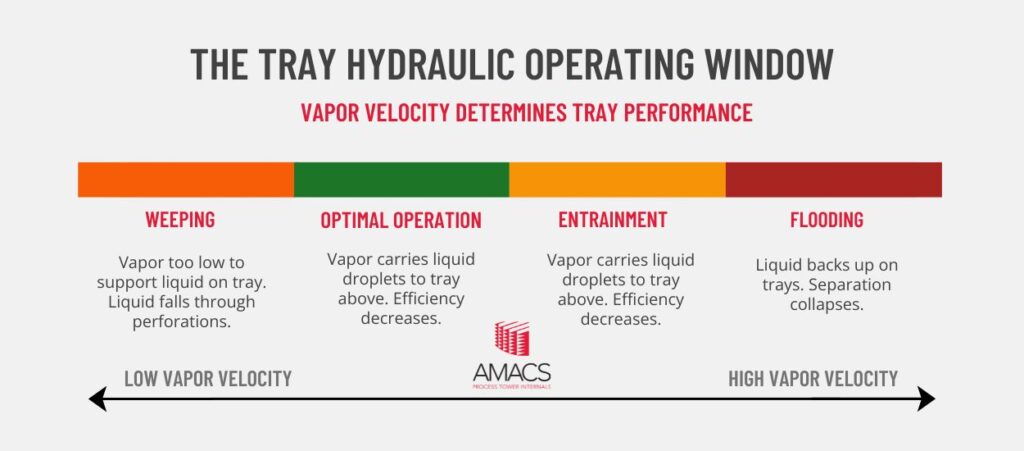
In a properly operating tray column, vapor rises through the tray perforations or valve openings and contacts the liquid flowing across the tray deck. Liquid accumulates to a controlled depth on the tray, flows across to the downcomer, and drops to the tray below. Separation happens at the vapor-liquid interface: the more intimate the contact, the better the mass transfer.
The key constraint is that this process only works within a specific vapor velocity range. Too much vapor and the column floods. Too little vapor and the column weeps. Both destroy the vapor-liquid contact that makes separation work. Entrainment is a separate but related problem: it occurs when vapor carries liquid droplets up to the next tray, even before full flooding sets in.
Getting the diagnosis right determines whether the fix is operational or mechanical.
Failure Mode Quick Reference
| Failure Mode | Vapor Rate | Root Cause | Key Indicator | First Response |
|---|---|---|---|---|
| Flooding | Too high | Liquid accumulates faster than downcomers can drain it | Sharp, nonlinear differential pressure spike | Reduce vapor load |
| Weeping | Too low | Vapor can’t support liquid on tray deck; liquid falls through perforations | Efficiency loss at low throughput; subtle ΔP change | Increase vapor rate; assess tray design |
| Entrainment | Too high (approaching flood) | Vapor carries liquid droplets to the tray above | Gradual efficiency loss correlating with vapor rate | Reduce vapor rate; inspect mist elimination |
What Causes Flooding in a Distillation Column
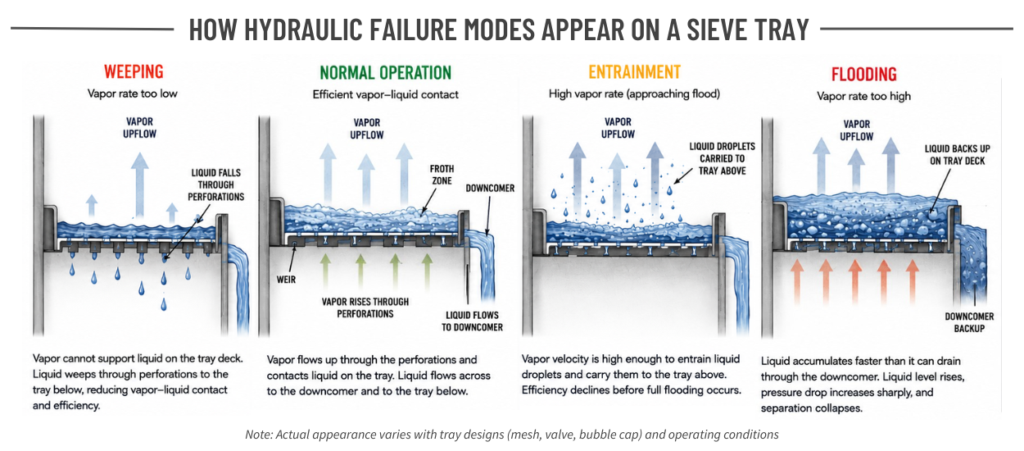
Flooding is the condition where liquid accumulation in the column exceeds the tray’s capacity to handle it. Once flooding begins in one section, it tends to propagate rapidly — liquid backs up from tray to tray until column performance collapses.
There are two distinct mechanisms:
Downcomer backup flooding occurs when liquid flowing down through the downcomer cannot exit fast enough. Downcomer capacity is limited by cross-sectional area, the clear liquid seal at the bottom, and the pressure drop across the tray below. When downcomer backup reaches the tray above, the tray deck floods and liquid carryover begins.
Jet flooding (entrainment flooding) occurs at high vapor velocities even when the downcomer is functioning correctly. Vapor jets through tray openings with enough energy to atomize liquid into droplets carried to the tray above. As entrainment increases with vapor rate, the tray above eventually receives more liquid than it can process — and the column floods from the top down.
How to Identify Flooding in a Distillation Tower
The most reliable indicator of flooding is a sudden, sharp increase in column differential pressure. As liquid accumulates between trays, the pressure drop across the flooded section rises steeply. In a healthy column, differential pressure moves gradually with feed rate and reflux changes. A rapid, nonlinear pressure rise at a specific vapor rate is the clearest operational signature of flooding.
Other indicators:
- Product quality degradation that correlates with high-vapor-rate conditions
- Temperature profile distortion — flooded trays show flattened temperature gradients in the flooded section
- Gamma scan profiles showing elevated liquid holdup across a defined section of the column
Operating Solutions vs. Mechanical Fixes for Column Flooding
If flooding is occurring at or near the design vapor rate, the tray may be operating near its hydraulic limit. Reducing feed rate or adjusting reflux ratio to lower the vapor load is the immediate operating response.
If flooding begins well below the design vapor rate, the problem is mechanical: damaged downcomers, fouled tray decks reducing effective open area, corroded or deflected tray floors, or improperly installed trays after the last turnaround. These conditions cannot be corrected at the operating level. The column needs to open and the internals need to be inspected and repaired or replaced.
What Causes Weeping in a Distillation Column
Weeping occurs when vapor velocity drops below the minimum required to support liquid on the tray deck. Instead of flowing across the tray and down through the downcomer in a controlled manner, liquid falls directly through the tray perforations or valve openings to the tray below.
In sieve trays, weeping occurs through fixed perforations when upward vapor pressure is insufficient to counteract the static head of liquid on the tray. In valve trays, the valves begin to close at low vapor rates, providing some resistance — but not indefinitely.
Severe weeping, where a significant fraction of liquid bypasses the tray entirely, is called dumping. In a dumped tray, there is essentially no vapor-liquid contact and separation efficiency collapses to near zero.
How to Identify Weeping in a Distillation Tower
Weeping is harder to identify from operating data than flooding because differential pressure changes are more subtle. Key indicators:
- Efficiency loss disproportionate to the reduction in throughput — the column doesn’t separate as well as expected even at low rates
- Product purity problems that worsen as feed rate drops below a certain threshold
- Temperature profiles showing less separation than expected between adjacent trays
- In gamma scanning, weeping shows as reduced liquid holdup across affected trays rather than the elevated holdup characteristic of flooding
Columns running at partial throughput — during startup, turndown conditions, or after a feed reduction — are most susceptible.
Operational Solutions vs. Mechanical Fixes for Column Weeping
Mild weeping is tolerable in many columns and does not always require intervention. Severe weeping at normal throughput indicates that trays are either improperly sized for actual operating conditions or that operating conditions have shifted significantly from the design basis.
If the operation has changed — different feed composition, different throughput targets, different product specifications — the tray design may no longer match the duty. This is a revamp scenario: new internals designed around the actual operating envelope.
If operating conditions haven’t changed, weeping at design throughput may indicate mechanical degradation: enlarged perforations from corrosion, warped or buckled tray floors, or debris partially blocking downcomers. Inspection at the next turnaround is warranted.
What Causes Entrainment in a Distillation Column
Entrainment occurs when vapor rising from a tray carries liquid droplets mechanically upward to the tray above, rather than allowing that liquid to flow down through the downcomer. The result is backmixing of composition across tray stages, reducing the effective number of theoretical stages the column provides.
Some degree of entrainment is present in virtually all operating tray columns. At low levels, the efficiency penalty is modest. As vapor rate increases, entrainment increases rapidly — typically with a power law relationship to vapor velocity. At high entrainment rates, the efficiency loss becomes severe, and at the extreme, entrainment transitions into jet flooding.
Entrainment is not a failure of the tray to hold liquid. The liquid level on the tray may look normal. The problem is that a fraction of that liquid is being carried overhead rather than processed by the tray.
How to Identify Entrainment in a Distillation Tower
Entrainment-related efficiency loss is difficult to distinguish from other causes of poor separation based on operating data alone. The clearest indicators:
- Efficiency loss that correlates with vapor rate increases, even before differential pressure rises sharply
- A “soft” flooding behavior where column performance degrades gradually with vapor rate rather than collapsing at a clear threshold
- High-capacity operation where the column was previously performing adequately at similar throughputs
In columns where entrainment is suspected but not confirmed, gamma scanning can differentiate between normal tray liquid holdup and liquid carryover by identifying elevated density in the vapor space above the tray deck.
How to Fix Entrainment in a Distillation Column
Entrainment is primarily a design constraint. If a column is exceeding its original design vapor rate, entrainment is expected to increase. The operating fix is to reduce vapor rate to the appropriate range.
If entrainment is occurring at or below design vapor rates, the cause is usually one of the following: damaged or missing mist eliminators, tray spacing that is too tight for the liquid load, or tray geometry generating high-velocity jets rather than distributed bubbling. These are mechanical issues requiring internal inspection and potentially a redesign of the tray geometry or installation of high-efficiency trays.
AMACS designs and manufactures high-performance trays and conventional trays engineered to the specific operating envelope of the column, including systems with entrainment constraints that standard sieve tray designs cannot meet.
When Diagnosis Requires More Than Operating Data
Operating parameters — differential pressure, temperature profiles, product quality — can identify that a hydraulic problem exists and often suggest which failure mode is responsible. But they cannot tell you the condition of the internals themselves.
Gamma scanning is the most valuable diagnostic tool for active columns because it maps liquid holdup across the column height without requiring a shutdown. A gamma scan can distinguish between flooded trays, weeping trays, and normal operation, and can identify specific sections where internals damage is concentrated.
Internal inspection during a turnaround provides the definitive picture: tray floor condition, downcomer integrity, weir height uniformity, corrosion patterns, fouling deposits, and mechanical damage from previous upsets. The combination of gamma scan data and internal inspection gives you the information needed to make decisions about repair, replacement, or revamp — rather than operating around a problem that will continue to cost throughput and product quality.
AMACS Capabilities
AMACS provides distillation column internals including sieve trays, valve trays, high-performance trays, structured packing, random packing, liquid distributors, and mist eliminators for trayed and packed distillation towers across refining, petrochemical, and gas processing service.
Our turnaround services team supports field installation, hardware assessment, and emergency replacement for columns coming out of service with internals damage. If you’re troubleshooting a distillation tower performance problem or planning an upcoming turnaround inspection, contact AMACS to discuss solutions.
Frequently Asked Questions
Flooding and weeping are opposite hydraulic failure modes in tray columns. Flooding occurs when vapor velocity is too high — liquid accumulates faster than it can drain through the downcomers, eventually backing up and collapsing column performance. Weeping occurs when vapor velocity is too low — liquid falls through the tray perforations rather than flowing across the tray deck and through the downcomer. Both destroy vapor-liquid contact and reduce separation efficiency, but their causes and corrections are different.
The most reliable indicator of flooding is a sharp, nonlinear increase in column differential pressure that correlates with vapor rate. In a healthy column, differential pressure increases gradually with throughput. Flooding produces a steep rise at a specific vapor velocity threshold. Temperature profile distortion in the flooded section and product quality degradation at high throughput are supporting indicators. Gamma scanning can confirm flooding by mapping elevated liquid holdup between specific trays.
Entrainment is caused by vapor rising through the tray at high enough velocity to atomize liquid droplets and carry them to the tray above. The primary cause is operating at high vapor rates relative to tray design. Mechanical factors — tray geometry, tray spacing, and the condition of mist elimination equipment — also influence entrainment rates at a given vapor velocity.
Yes, though the minimum vapor velocity threshold before weeping begins differs between tray types. Sieve trays are most susceptible because the perforations are fixed and provide no resistance at low vapor rates. Valve trays partially close at low vapor rates, providing some resistance. High-performance trays often incorporate design features that extend the operating range compared to conventional sieve trays. The specific weeping threshold depends on tray geometry, hole size, liquid rate, and the physical properties of the system.
Tray replacement or redesign is warranted when flooding, weeping, or entrainment is occurring significantly below design throughput (indicating mechanical damage or design mismatch); when operating conditions have permanently changed from the original design basis and existing trays can no longer provide adequate efficiency; or when internal inspection reveals corrosion, warping, or mechanical damage that cannot be repaired in place. Operating adjustments can manage symptoms but don’t address mechanical root causes.