
Mist Eliminator Selection: Mesh Pads, Vane Separators, and Wedge Wire Compared
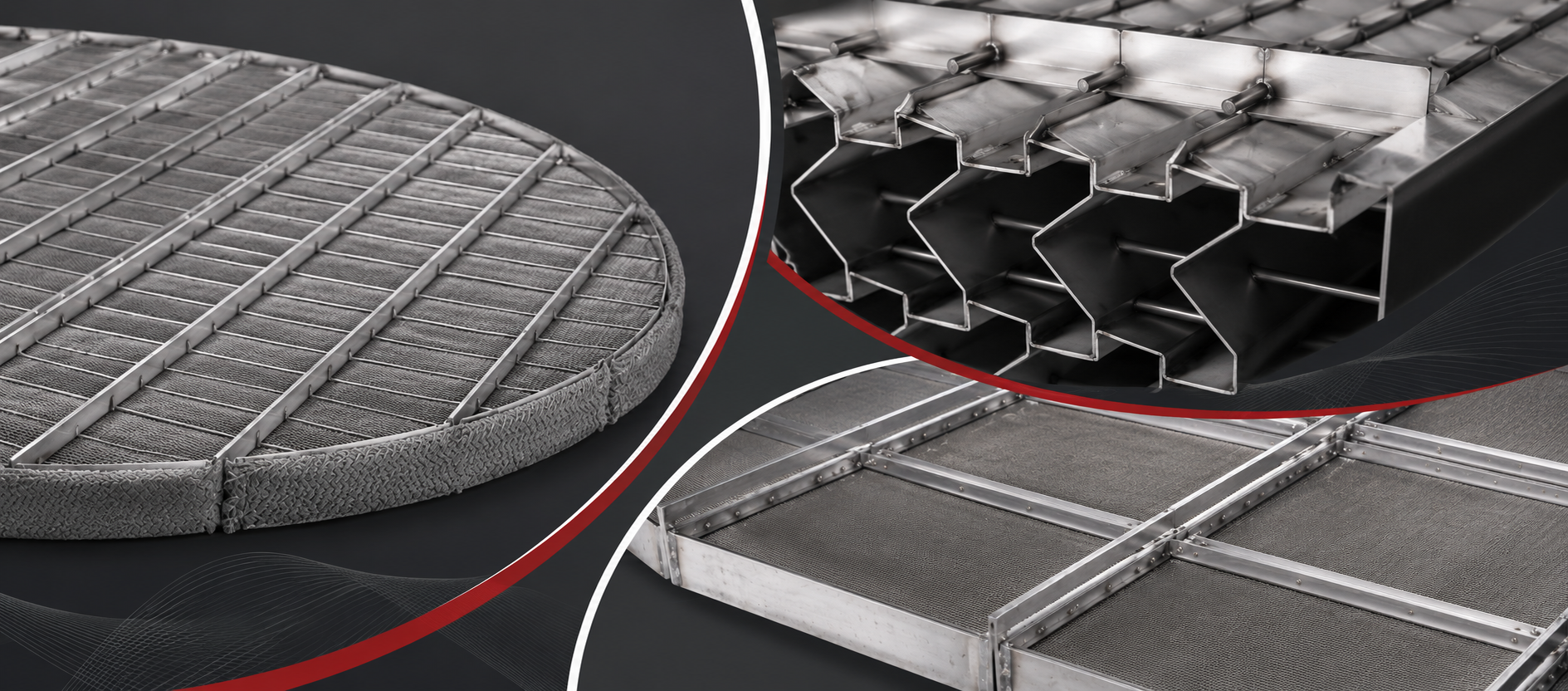
Entrainment control is a standard requirement across gas-liquid separation equipment, absorption columns, distillation towers, and process vessels. The mist eliminator category addresses that requirement, but it isn’t a single product — it’s a family of devices with meaningfully different operating envelopes. Selecting the wrong type for a given application produces predictable outcomes: liquid carryover, re-entrainment at elevated velocities, fouling-related plugging, or excessive pressure drop.
Mesh mist eliminator pads, vane separators, and wedge wire mist eliminators each occupy a distinct performance range. Understanding where they overlap and where they diverge is what drives a defensible selection.
What Mist Eliminators Do in a Process Column
Liquid entrainment occurs when a rising vapor stream carries droplets upward rather than allowing them to fall back into the liquid phase. In distillation and absorption columns, entrained liquid degrades separation efficiency by contaminating the vapor product and disrupting tray or packing hydraulics. In gas-liquid separators and knockout drums, carryover contaminates downstream equipment and process streams.
A mist eliminator is a physical separation device installed in the vapor space of a vessel or column to intercept and coalesce entrained droplets before they exit with the gas. Captured liquid drains back into the liquid phase by gravity. The device does not chemically alter the stream — it exploits differences in inertia, momentum, and surface tension between the vapor phase and entrained liquid droplets.
Effective mist elimination depends on three variables that interact with device geometry: vapor velocity, droplet size distribution, and liquid loading. No single device type optimizes all three simultaneously, which is why selection requires matching device characteristics to the specific process conditions in play.
Mesh Mist Eliminator Pads
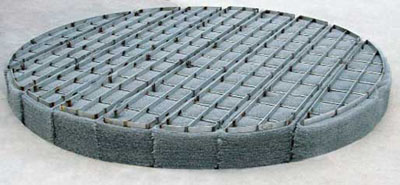
Knitted wire mesh mist eliminators are fabricated as multiple layers of crimped wire mesh compressed to a target density and thickness, then framed with a structural grid on each face. The resulting pad is an open, high-surface-area matrix through which vapor flows while entrained droplets impinge on wire filaments, coalesce, and drain downward.
The separation mechanism is impaction and retention. As vapor flows through the mesh matrix, it deflects around wire strands. Droplets, having greater inertia than the gas, cannot follow the deflecting streamlines and instead contact the wire surface. Coalesced liquid accumulates until droplet weight exceeds surface tension, at which point it falls away from the pad. Mesh pads are effective across a broad droplet size range and perform well at moderate vapor velocities in clean service.
The Souders-Brown equation governs velocity design for mesh pads, with typical capacity factors of 0.35 ft/sec for vertical vapor flow and 0.42 ft/sec for horizontal flow in an air-water system at ambient conditions. These values derate at elevated operating pressure and with changes in fluid physical properties.
The practical limitation of standard mesh pads is drainage capacity at high liquid loads. When liquid accumulation in the lower portion of the pad exceeds the drainage rate, the liquid zone grows upward through the pad. At the point where the liquid-filled zone reaches the vapor inlet face, the pad floods and liquid is re-entrained rather than separated. High-fouling service presents a separate failure mode: solid deposition or viscous liquid accumulation blocks the mesh matrix, increasing pressure drop and reducing open area until the pad is no longer functional.
MaxCap® and High-Capacity Mesh Configurations
For applications where drainage limitation rather than impaction efficiency is the binding constraint, AMACS developed the MaxCap® Mist Eliminator. The design uses proprietary internal geometry to improve liquid drainage from the pad without requiring a change to a different separator type. The result is a higher allowable vapor velocity compared to a standard 9 lb/ft³ density mesh pad, along with improved impaction efficiency for fine droplets. MaxCap® is appropriate when operating conditions approach the drainage limit of a conventional mesh pad but where mesh impaction characteristics remain preferable to vane or wedge wire alternatives.
AMACS mesh mist eliminators are available in metallic and non-metallic knitted mesh across a range of wire diameters and densities — from 5 lb/ft³ open-weave styles to 12 lb/ft³ high-surface-area configurations — to match the droplet capture requirements and pressure drop constraints of the application.
Vane Mist Eliminators
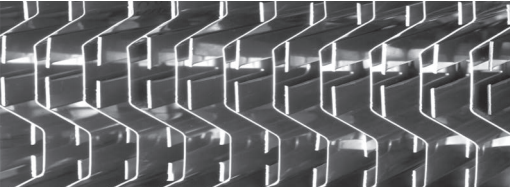
Vane mist eliminators — sometimes called chevron separators — operate on inertial impaction through a fundamentally different geometry than mesh pads. Parallel corrugated plates create a sinuous flow path that forces the vapor stream through a series of directional changes. Droplets, unable to follow the sharp turns, impinge on the vane surfaces, coalesce, and drain away. The open channel geometry of vane separators gives them a meaningfully different performance envelope than mesh pads.
Vanes handle higher vapor velocities, heavier liquid loads, and are substantially more resistant to fouling than mesh pads because the open passage geometry does not trap solids or viscous material in the same way a dense mesh matrix does. Typical Souders-Brown capacity factors for vane separators run from 0.5 ft/sec for non-pocketed vertical flow up to 0.85 ft/sec for pocketed horizontal flow — significantly higher than mesh pad values. The trade-off is that vanes are less effective at capturing very fine droplets, since the inertial separation mechanism requires minimum droplet momentum to achieve impingement.
Standard and Pocketed Vane Configurations
AMACS PLATE-PAK™ Vanes are a standard non-pocketed configuration where the vane profile geometry itself creates hydraulic pockets that promote drainage. Standard vanes offer low pressure drop and are the preferred choice where fouling resistance is a primary concern. Multiple plate spacings are available to tune impaction characteristics for different droplet size distributions, and the design accommodates both horizontal and vertical vapor flow.
Pocketed vane configurations increase liquid handling capacity further by adding physical liquid collection pockets to the vane blades. The pockets allow captured liquid to pool and drain in a protected zone away from the main vapor stream, preventing re-entrainment at elevated velocities. AMACS Multi-Pocket™ Vane blades are configured to minimize in-pocket turbulence while maintaining low pressure drop. For applications with heavy liquid loading at high vapor velocities, pocketed vanes extend the operating envelope beyond what standard non-pocketed designs can sustain.
For applications requiring higher capacity or fouling resistance than mesh pads provide, AMACS vane mist eliminators — including both PLATE-PAK™ and Multi-Pocket™ configurations — are available in horizontal and vertical flow arrangements across a range of plate spacings and alloys.
Wedge Wire Mist Eliminators

The engineering behind wedge wire addresses process conditions where knitted mesh construction is not viable — primarily applications with significant fouling potential, solid particle loading, or aggressive chemical environments where mesh matrix plugging is a predictable failure mode.
Wedge wire is fabricated by helically wrapping a V-shaped profile wire around longitudinal support rods, with all contact points resistance welded. The resulting structure creates precise, controlled slot openings with a geometry that resists plugging: the V-profile means openings are widest at the back of the slot, so any particle that passes the narrow inlet face moves into progressively larger space rather than becoming lodged. This self-clearing characteristic is the defining performance advantage over knitted mesh in fouling service.
In mist elimination service, wedge wire elements intercept and coalesce liquid droplets through the same inertial and surface-tension mechanisms that govern mesh pads, but in an open, cleanable structure that can be backwashed or mechanically cleaned without damage. Refinery and petrochemical applications with hydrocarbon streams carrying particulates, polymerizing compounds, or viscous components are the primary use case. Wedge wire mist eliminators are also specified where CIP (clean-in-place) or periodic backwash capability is a design requirement.
AMACS wedge wire screens are fabricated in nearly any alloy — including duplex stainless, Hastelloy, Inconel, and titanium — with slot sizes and open area configurable to the specific process conditions and cleanability requirements of the application. See full details in the Wedge Wire Brochure.
Comparing Selection Criteria Across Mist Eliminator Types
Mist eliminator selection reduces to five variables. How each device type responds to those variables determines which is appropriate for a given application.
Vapor Velocity
Mesh pads operate within a relatively narrow velocity window. Below the minimum, droplet momentum is insufficient for impaction. Above the maximum, re-entrainment from the pad surface occurs. Vane separators tolerate a wider and generally higher velocity range, particularly in pocketed configurations. Wedge wire elements are designed around the specific application and can be configured for a range of velocities depending on slot geometry and open area.
Droplet Size Distribution
Mesh pads are effective across a broad droplet size range, including sub-10-micron droplets, because the high surface area of the mesh matrix provides numerous impaction sites even for small droplets with low inertia. Vane separators are most effective for droplets above approximately 10–40 microns, where inertial impaction at directional changes is reliable. For very fine mist with droplet sizes below the effective range of vanes, mesh pads or mesh-vane combinations are the standard approach.
Liquid Loading
Standard mesh pads are drainage-limited at high liquid loads. High-capacity mesh configurations like MaxCap® extend this range. Vane separators — particularly pocketed designs — handle heavy liquid loads more reliably than mesh pads because the open channel geometry drains continuously rather than accumulating liquid within a matrix. For the heaviest liquid loading conditions, vane separators are typically preferred.
Fouling and Solids
This is the variable that most clearly differentiates the three types. Clean service with no solids or polymerizing components is where mesh pads perform best. Any service with meaningful solid particle loading, wax, polymer, or viscous liquid accumulation shifts the selection toward vane separators or wedge wire. Vanes are more fouling-resistant than mesh due to their open geometry. Wedge wire provides the highest fouling resistance and the only practical backwash capability.
Pressure Drop
All three types are low-pressure-drop devices relative to other column internals, but they differ within that range. Vane separators generally operate at lower pressure drop than dense mesh pads. Wedge wire pressure drop depends on slot size and open area, and is configurable for the application. Where pressure drop minimization is a hard constraint, vane separators are often the preferred choice.
Selecting the Right Mist Eliminator for Your Application
Mist eliminator selection is rarely a one-variable decision. AMACS works with process engineers and procurement teams across refining, petrochemical, and industrial process industries to evaluate those variables and specify the mist eliminator configuration that fits the application. If you’re working through a selection decision or evaluating options for an upcoming turnaround, contact an AMACS expert to discuss your requirements.
Frequently Asked Questions
A mist eliminator pad is a knitted wire mesh device installed in a process column or vessel to intercept and coalesce entrained liquid droplets carried by a rising vapor stream. The pad is fabricated from multiple layers of crimped wire mesh compressed to a specific density and framed with a structural grid. Droplets impinge on wire strands, coalesce into larger droplets, and drain back into the liquid phase by gravity. Mesh pads are the most common mist eliminator type in general process service.
Vane mist eliminators are preferred over mesh pads when vapor velocity exceeds the drainage capacity of a standard mesh pad, when liquid loading is heavy, when fouling resistance is a design requirement, or when the process involves droplets large enough for reliable inertial impaction at vane surfaces — generally above 10–40 microns. Vane separators are also commonly specified in horizontal vessel applications where their geometry accommodates horizontal vapor flow efficiently.
Wedge wire mist eliminators use a V-profile wire welded to support rods to create a rigid, open-slot structure rather than a compressed mesh matrix. The primary difference is fouling resistance: the wedge wire geometry resists plugging by solids or viscous material and can be backwashed or mechanically cleaned without damage. Knitted mesh pads offer superior performance for fine droplet capture in clean service, but are not suitable where solid loading or fouling is a material process condition.
Yes, in many cases. AMACS MistFix® Mist Eliminators are designed specifically for retrofit applications where the existing vessel has no internal mist eliminator support or restricted internal access. The MistFix® drops into the top gas outlet nozzle and hangs from the flange, requiring no vessel modification. For other retrofit configurations, AMACS engineers can evaluate existing vessel geometry and specify a mist eliminator design compatible with available support attachment points.