
Random Packing Selection: Balancing Capacity and Efficiency in Packed Columns

Random packing is one of three primary mass transfer devices used in distillation, absorption, and stripping columns — alongside structured packing and trays. Its function is to create surface area for vapor/liquid contact inside a packed column so that thermodynamic separation can occur. Vapor rises under heat and pressure while liquid falls under gravity, and the random packing bed creates the contact surface where those two streams interact and exchange components.
Selecting the right random packing for a given service requires balancing three variables that cannot all be optimized simultaneously: capacity, efficiency, and cost. How that balance is struck — and which variable takes priority — depends on the specific combination of throughput requirements, separation targets, operating pressure, fouling potential, and column geometry in play. Getting that balance wrong rarely produces immediate failure. More often it produces a column running short of its capacity target, underperforming on separation, or requiring more frequent intervention than it should.
The Core Tradeoff for Random Packed Columns: Capacity vs. Efficiency
In random packing selection, capacity and efficiency move in opposite directions as packing size changes — and the reason is geometric.
Larger random packing creates a bed with more open area between pieces. That open area reduces vapor velocity resistance, allowing higher throughput before hydraulic flooding limits column operation. But larger pieces provide less total surface area per unit of bed volume, which means fewer vapor/liquid contact points per theoretical stage and lower separation efficiency — measured as HETP, or height equivalent to a theoretical plate.
Smaller random packing increases surface area density and improves efficiency — lower HETP — but at the cost of reduced open area, higher pressure drop across the bed, and greater sensitivity to flooding at elevated vapor rates. Smaller packing also costs more per unit volume.
The design engineer’s task is finding the packing size and geometry that delivers the most economical balance of capacity and efficiency for the specific service. That balance point is different for every application, and it shifts further depending on which generation of random packing is specified.
How Packing Generation Shifts the Balance Point
Random packing geometry has evolved significantly across three generations. Each generation shifted the capacity/efficiency balance point in favor of the engineer — delivering more of both without requiring a tradeoff as steep as the one that came before.
First generation — Raschig Rings are characterized by equal height and diameter. They offer relatively low capacity, low efficiency, and high cost relative to performance. Their primary application today is limited to extreme temperature or highly corrosive services where ceramic or carbon/graphite construction is required and performance expectations are adjusted accordingly.
Second generation — Pall Rings introduced windows and internal tabs to the Raschig Ring geometry, opening up flow paths and creating internal drip points that improved vapor/liquid contact. The result was a 50–80% improvement in both capacity and efficiency at comparable size — a significant advance that made Pall Rings the standard for absorption, stripping, and distillation services for decades. High-performance third-generation random packing has largely replaced Pall Rings where column performance is a priority, though Pall Rings remain widely installed in existing columns.
Third generation — High Performance Saddle Rings introduced low aspect ratio geometry, where packing height is less than nominal diameter. This promotes a more oriented fill pattern in the packed bed: flat surfaces settle parallel to vapor and liquid flow rather than perpendicular, increasing capacity while preserving effective surface area for vapor/liquid contact. The AMACS Saddle Ring Packing — the mechanical equivalent of IMTP® — delivers higher capacity and efficiency than comparable Pall Ring sizes across atmospheric and high-pressure distillation, demethanizers, deethanizers, acid gas removal, quench towers, and main fractionators.
SuperBlend™ 2-Pac: Reducing the Tradeoff Itself
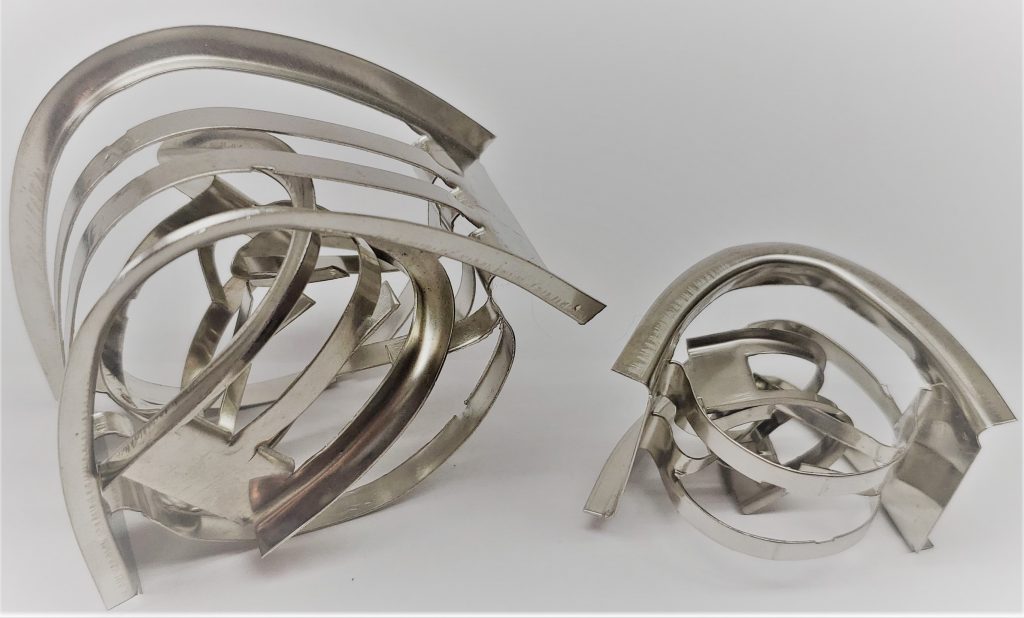
The capacity/efficiency tradeoff in random packing is a physical constraint — but it is not absolute. AMACS’s patented SuperBlend™ 2-Pac technology was developed specifically to reduce it.
SuperBlend™ 2-Pac combines two different sizes of high-performance saddle ring packing in a single bed. The smaller packing fills the interstitial void spaces between larger pieces — space that would otherwise contribute nothing to mass transfer. This adds effective vapor/liquid contact surface area without blocking the open flow paths that give larger packing its capacity and pressure drop advantage.
The result, verified by independent third-party testing at the Separations Research Program (SRP) at the University of Texas: a 25% increase in column efficiency or a 15% increase in column capacity compared to a single-size random packing bed of equivalent depth.
For retrofit applications where column diameter and bed height are fixed constraints, SuperBlend™ 2-Pac delivers meaningful performance improvement without a column revamp. Applications include absorption and stripping, fine chemical distillation, refinery fractionators, and retrofit capacity or efficiency upgrades where modifying the existing vessel is not practical.
Pressure Drop as a Binding Constraint
In most services, pressure drop across the random packing bed is an operating cost consideration. In vacuum distillation, it becomes the binding constraint on packing selection.
Column pressure drop in vacuum distillation translates directly into bottom temperature requirements. Excessive pressure drop forces the reboiler to operate at higher temperatures to maintain the overhead vacuum target — creating thermal degradation risk for heat-sensitive products and increasing energy consumption across the column. In these services, minimizing pressure drop per theoretical stage takes priority over maximizing efficiency or capacity, which typically favors larger random packing or a shift to structured packing rather than smaller high-efficiency random packing.
For atmospheric and above-atmospheric distillation, absorption, and stripping services, pressure drop is real but rarely a safety or product quality constraint. Here the capacity/efficiency tradeoff dominates, and random packing selection can optimize for separation performance within the column’s hydraulic limits.
Fouling Service: A Structural Advantage for Random Packing
Fouling potential is one of the clearest decision points in packed column internals selection, and it consistently favors random packing over conventional structured packing.
High-performance structured packing — corrugated sheet metal, gauze, knitted mesh — depends on clean, well-distributed liquid to maintain its efficiency advantage. The narrow corrugation channels that give structured packing low pressure drop and high efficiency also trap solids, scale, and contaminants as fouling accumulates. Columns in fouling service with conventional structured packing see efficiency and capacity fall off between turnarounds as channels restrict and liquid distribution degrades.
Random packing tolerates fouling better because the irregular bed geometry provides larger open areas and multiple flow pathways through the packed column. As fouling accumulates, performance declines more gradually and more predictably than in structured packing beds. For moderate fouling service — refinery fractionators, quench towers, absorbers handling dirty streams — high-performance random packing is typically the practical and economical choice.
For severe fouling service, AMACS Grid Structured Packing extends operability into conditions that would plug conventional internals. For the broad middle range of refinery and chemical plant fouling service, third-generation random packing is the default that performs reliably between turnarounds.
Replacement and Turnaround Decisions
For turnaround coordinators and maintenance engineers replacing random packing, the selection decision is not always a straight in-kind replacement. A turnaround is the practical window for evaluating whether the current packing generation and size remain the right specification for the column’s current operating demands — which may have changed since original design.
Columns that have been debottlenecked, re-rated, or shifted to different feed compositions may be running original random packing outside its optimal range. A packing review during the turnaround planning phase, using current operating data against available packing options, can identify whether an upgrade to third-generation packing or a SuperBlend™ 2-Pac configuration delivers measurable improvement within the existing vessel.
AMACS maintains random packing stock in Houston for turnaround replacement needs, including the capability to manufacture certain random packings in special materials when standard stock does not meet service requirements. For teams working against tight outage windows, in-stock availability removes one of the most common sources of schedule pressure in packing replacement.
The American Institute of Chemical Engineers (AIChE) recognizes packed column design and packing selection as a core competency in mass transfer engineering — a reflection of how significantly packing choice affects column operability, efficiency, and long-term reliability.